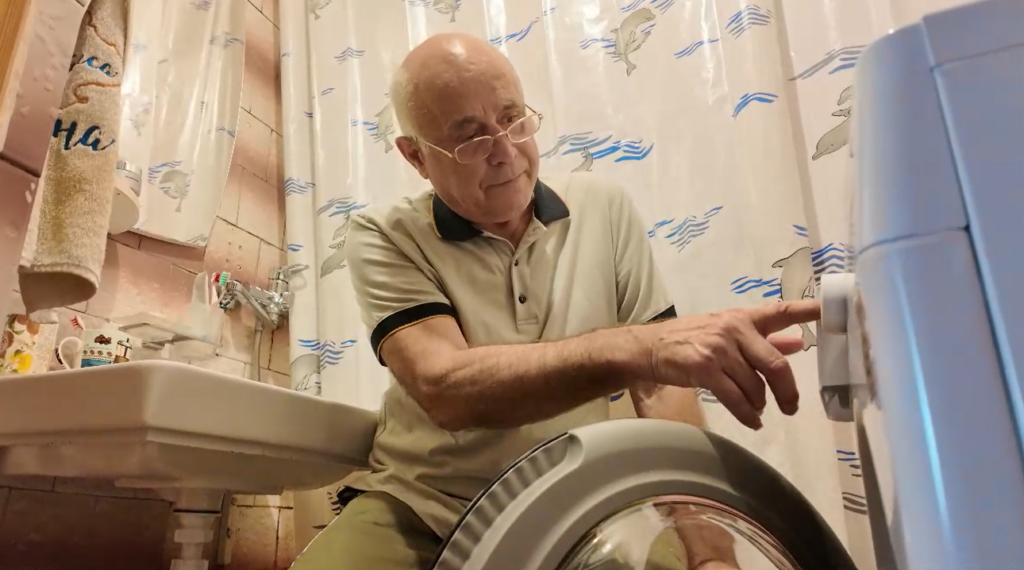
Fiodor Stratulat, a pensioner from the municipality of Chișinău, benefited from the EcoVoucher Program, through which he replaced his old washing machine with a new, energy-efficient one. For his family, investing in a modern household appliance had been necessary for a long time, but the high costs made such a purchase difficult.
Fiodor Stratulat lives with his wife and mother-in-law. Although the family carefully manages its expenses and always tries to choose cost-effective products, the washing machine they had been using for more than 20 years had become inefficient and consumed a significant amount of electricity.
During the same period, Fiodor Stratulat received a message informing him that he had been selected to receive a voucher worth MDL 6,000 under the EcoVoucher Program.
“Our washing machine had been working for more than 20 years. Every time we turned it on, we worried it might stop working at any moment. On top of that, it consumed a lot of electricity. When we received the notification, we were surprised. I asked my wife to verify the information online, and we found out that we had indeed been awarded the voucher. We called the number provided, and they confirmed that we could go to any partner store to purchase either a refrigerator or a washing machine,” says the beneficiary.
EcoVoucher – Valuable Support for the Family Budget
After confirming the voucher, the family decided to replace their washing machine, the appliance they needed most. The financial support provided through the EcoVoucher Program covered the majority of the cost of the new appliance. The purchasing process was quick and straightforward. The new washing machine was delivered to their home, while the old appliance was collected free of charge for recycling.
“We went to the store and compared the available options. The washing machine cost around MDL 9,000–10,000, and in the end we only had to pay about MDL 2,500 ourselves. It is a great help for our family budget. They delivered the machine at a convenient time, carried it up to the third floor, and immediately took away the old appliance. Everything was very simple,” recalls Fiodor Stratulat.
For the Stratulat family, replacing the old appliance means not only greater comfort but also lower electricity bills. Before purchasing the new washing machine, the household spent more than MDL 1,000 per month on electricity, and the beneficiary is confident that an energy-efficient appliance will help reduce these costs.
“We pay close attention to our electricity consumption and always try to choose the most energy-efficient appliances. My wife always checks how much each appliance consumes and whether it is energy efficient. The money we save on electricity can be used for other family needs,” Fiodor Stratulat added.
The beneficiary believes that the EcoVoucher Program provides meaningful support to people who need modern household appliances but cannot always afford to buy them.
“This program is truly useful. Many people would like to own such appliances but simply cannot afford them. Receiving a voucher like this is a welcome form of support,” he says.
What Does the EcoVoucher Program Offer?
● Government support for purchasing a new energy-efficient household appliance that consumes less electricity and helps reduce energy bills;
● A voucher worth MDL 6,000, covering up to 70% of the cost of a refrigerator (energy classes A-D) or a washing machine (energy class A);
● Access to modern, energy-efficient appliances that comply with European standards;
● Free collection and recycling of the old appliance.
Priority is given to families with two or more children and households where two people aged over 63 live together.
The EcoVoucher Program is developed by the Government of the Republic of Moldova with the financial support of the European Union. The current edition is implemented by the National Center for Sustainable Energy (NCSE) under the project “Energy Efficiency and Renewable Energies for Moldova” (E4M), implemented by GIZ together with the Government of the Republic of Moldova, financed by the Government of Germany and co-financed by the European Union, Norway, and Denmark. The current edition of the Program is funded by the European Union.